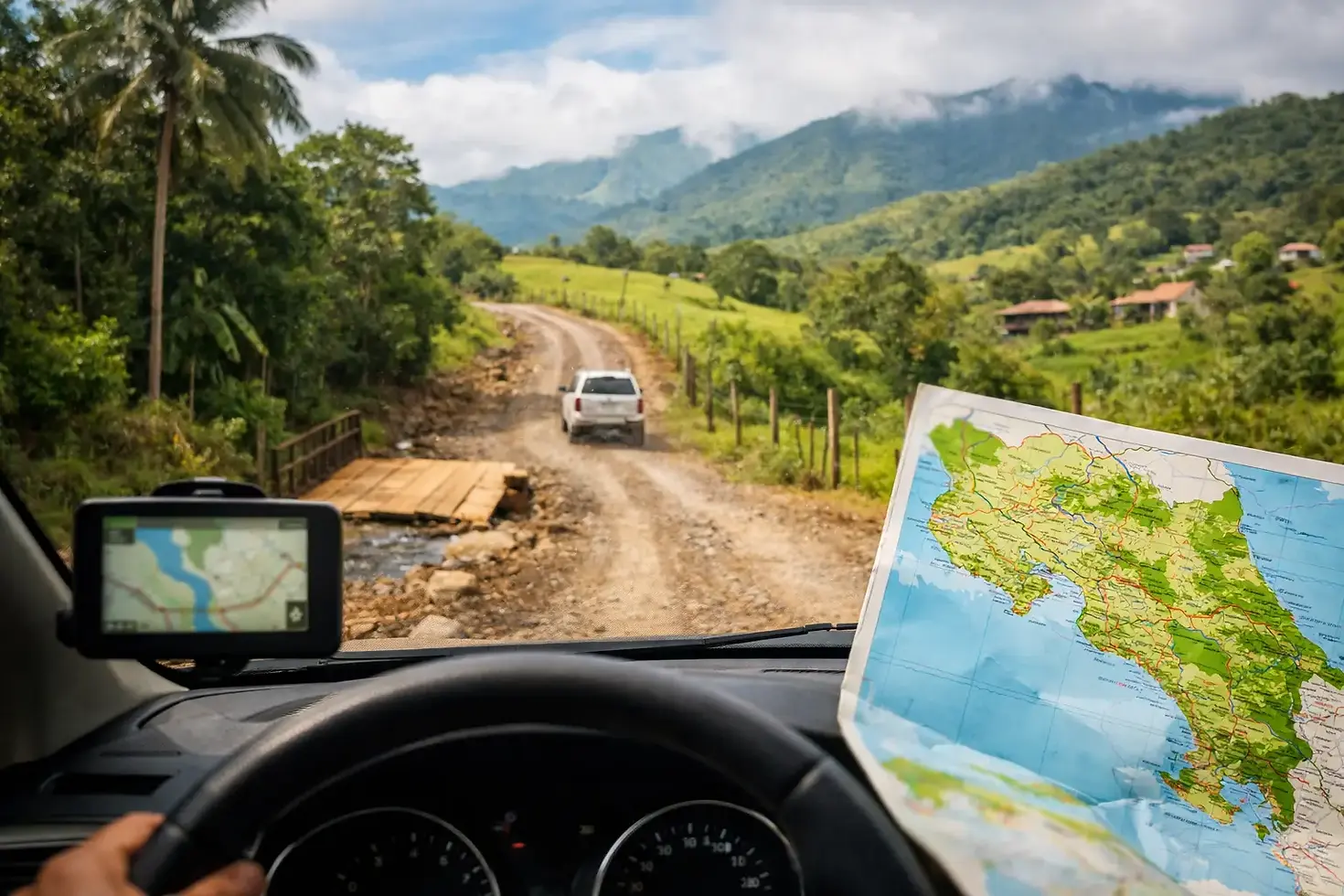
Rural Road Navigation Tips for Costa Rica Trips

A route can look simple on a map: leave the airport, follow one highway, turn toward the coast or mountains, and arrive before dinner. Rural road navigation in Costa Rica often tells a different story. The final 20 miles may take an hour, a bridge may be narrow, rain can change road conditions quickly, and the road your app selects may not be the road you want to drive after dark.
For travelers, new residents, and business visitors, the goal is not just reaching the destination. It is arriving safely, on time, and without turning the trip into a stressful guessing game. A little local planning makes a major difference.
Why Rural Road Navigation Requires More Planning
Costa Rica has excellent main routes connecting many major areas, but road conditions can change sharply once you leave them. Paved roads may become narrow and winding. A route may pass through small towns with limited signage, cross rivers, or include steep sections where a low-clearance rental car is not the right fit.
Travel time is the first common surprise. A distance that would take 45 minutes on a wide US highway can take much longer on a two-lane mountain road. Traffic behind trucks, sharp curves, roadwork, rain, animals, and local traffic all affect the clock. Treat estimated arrival times as a starting point, not a guarantee.
The second issue is route quality. Navigation apps are useful, especially for finding addresses and monitoring major traffic delays. But they do not always know whether a shortcut is muddy, heavily rutted, poorly maintained, or difficult for the vehicle you rented. A route that saves 10 minutes on screen may cost far more in time and stress on the ground.
Plan the Route Around Your Actual Vehicle
Before following any route into a rural area, consider the vehicle, not just the destination. A sedan can be perfectly suitable for many popular places during dry conditions, particularly when the property is close to a main road. It may be a poor match for a steep, unpaved driveway or a backroad after heavy rain.
Four-wheel drive is helpful in some regions, but it does not make every road safe. Drivers still need to judge water crossings, loose gravel, steep grades, and limited visibility. If you are unfamiliar with the road, avoiding unnecessary risk is smarter than trying to prove what the vehicle can handle.
Ask your hotel, vacation rental host, real estate contact, or transport provider a direct question: what is the road like for the final stretch? Ask whether it is paved, whether it has steep hills, whether a standard car can reach it, and whether conditions change in the rainy season. Specific information is more useful than being told the location is "easy to find."
Do Not Treat Every Map Shortcut as Equal
A shorter route can be the best option, but only when it suits current conditions. In rural areas, some roads are local connections rather than visitor-friendly corridors. They may have no streetlights, few places to turn around, and little traffic if something goes wrong.
If a navigation app suddenly directs you off a known paved road onto a narrow unpaved lane, pause before making the turn. Check the route details, compare alternatives, and consider the time of day. The longer paved route is often the better decision, especially when you have children, luggage, a flight connection, or a vehicle you do not know well.
Timing Matters More Than Most Visitors Expect
Daylight is one of the most useful tools for rural travel. Seeing the road clearly helps you spot potholes, cyclists, pedestrians, animals, drainage ditches, and missing shoulders. It also makes it easier to confirm landmarks when signs are limited.
For that reason, build extra time into airport arrivals and long transfer days. If your flight lands in the afternoon, a remote mountain or beach destination may be better reached with a planned stop along the way rather than a rushed nighttime drive. This is not always necessary, but it is worth considering when the last part of the route is unfamiliar.
Rainy-season travel needs extra flexibility. A hard afternoon downpour can reduce visibility quickly and make unpaved roads slippery. Creeks that are easy to cross in the morning may look very different after sustained rain. Slow down, keep more distance from other vehicles, and do not assume a road is passable just because a map shows it as a through route.
Use Navigation Technology, Then Verify It Locally
Download offline maps before heading into a rural region. Cellular coverage can be inconsistent in valleys, mountain areas, and stretches between towns. Offline maps will not tell you every current road condition, but they can keep you oriented if service drops.
Save the destination coordinates, accommodation phone number, and a screenshot of the final directions. Many rural properties are identified by landmarks rather than a conventional street number. A host may tell you to turn after a school, pass a soccer field, or look for a particular gate. Those details can be more reliable than an address entered into an app.
It also helps to keep enough fuel for the unexpected. Do not wait until the tank is nearly empty before leaving a larger town. Fuel stations are available across much of the country, but they are not equally convenient on every rural route, and changing plans are easier when you have a comfortable fuel margin.
Know When to Ask for Help
There is no prize for handling a difficult route alone. If directions seem unclear, call the destination before you reach the final turn. If you are uncertain about a water crossing, an isolated road, or a route after dark, choose a safer alternative or wait for guidance.
This is where a local driver can be more valuable than a vehicle and a map. A professional who drives these routes regularly understands which road is practical for the weather, where traffic typically slows, and when an alternate pickup point makes more sense. For airport transfers, tours, business appointments, or property visits, that knowledge removes a lot of avoidable pressure.
Tico Transfers can coordinate private transportation around the needs of your actual itinerary, whether that means an airport arrival, a long-distance transfer, a tour stop, or assistance getting to a location where directions are not straightforward. It is a practical option for travelers who would rather look out the window than study every turn.
Basic Habits That Make Rural Drives Safer
Keep your speed lower than you think you need to. Rural roads can change surface and width without warning, and local drivers may be used to conditions that are new to visitors. Use headlights when visibility is reduced, avoid passing unless there is a clear and legal opportunity, and watch for motorcycles and pedestrians near towns.
Avoid driving under pressure. A late reservation, a dinner booking, or a tight airport deadline can push people into bad decisions. If the route is taking longer than expected, communicate early with the people waiting for you. Most hotels, hosts, and service providers would rather receive an update than see you take chances to make up time.
Finally, remember that a rural road is part of the travel experience, not simply the gap between destinations. Give it the time, vehicle, and attention it deserves. When the route feels uncertain, choosing local guidance is often the easiest way to keep the journey comfortable from the first turn to the final gate.


Comments